Description
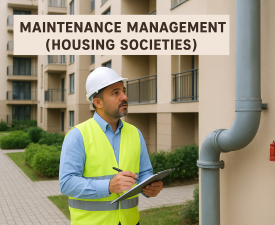
Course Name: Certificate in Maintenance Management (Housing Societies)
Course Id: CMMHS/Q0101.
Eligibility: 10+2 (Higher Secondary) or equivalent is required.
Objective:This course is designed to provide participants with thorough knowledge and skills needed to manage and maintain residential housing societies effectively. It covers key areas such as preventive maintenance, resource management, budgeting, vendor coordination, and regulatory compliance.
Duration: Three Months.
 How to Enroll and Get Certified in Your Chosen Course:
 Step 1: Choose the course you wish to get certified in.
Step 2: Click on the “Enroll Now” button.
Step 3: Proceed with the enrollment process.
Step 4: Enter your billing details and continue to course fee payment.
Step 5: You will be redirected to the payment gateway. Pay the course and exam fee using one of the following methods:
Debit/Credit Card, Wallet, Paytm, Net Banking, UPI, or Google Pay.
Step 6: After successful payment, you will receive your study material login ID and password via email within 48 hours of fee payment.
Step 7: Once you complete the course, take the online examination.
Step 8: Upon passing the examination, you will receive:
• A soft copy (scanned) of your certificate via email within 7 days of examination.
• A hard copy (original with official seal and signature) sent to your address within 45 day of declaration of result.
Step 9: After certification, you will be offered job opportunities aligned with your area of interest.
Online Examination Detail:
Duration- 60 minutes.
No. of Questions- 30. (Multiple Choice Questions).
Maximum Marks- 100, Passing Marks- 40%.
There is no negative marking in this module.
| Marking System: | ||||||
| S.No. | No. of Questions | Marks Each Question | Total Marks | |||
| 1 | 10 | 5 | 50 | |||
| 2 | 5 | 4 | 20 | |||
| 3 | 5 | 3 | 15 | |||
| 4 | 5 | 2 | 10 | |||
| 5 | 5 | 1 | 5 | |||
| 30 | 100 | |||||
| How Students will be Graded: | ||||||
| S.No. | Marks | Grade | ||||
| 1 | 91-100 | O (Outstanding) | ||||
| 2 | 81-90 | A+ (Excellent) | ||||
| 3 | 71-80 | A (Very Good) | ||||
| 4 | 61-70 | B (Good) | ||||
| 5 | 51-60 | C (Average) | ||||
| 6 | 40-50 | P (Pass) | ||||
| 7 | 0-40 | F (Fail) | ||||
 Key Benefits of Certification- Earning a professional certification not only validates your skills but also enhances your employability. Here are the major benefits you gain:
 Practical, Job-Ready Skills – Our certifications are designed to equip you with real-world, hands-on skills that match current industry demands — helping you become employment-ready from day one.
 Lifetime Validity – Your certification is valid for a lifetime — no renewals or expirations. It serves as a permanent proof of your skills and training.
 Lifetime Certificate Verification – Employers and institutions can verify your certification anytime through a secure and reliable verification system — adding credibility to your qualifications.
 Industry-Aligned Certification –All certifications are developed in consultation with industry experts to ensure that what you learn is current, relevant, and aligned with market needs.
 Preferred by Employers – Candidates from ISO-certified institutes are often prioritized by recruiters due to their exposure to standardized, high-quality training.
 Free Job Assistance Based on Your Career Interests – Receive personalized job assistance and career guidance in your preferred domain, helping you land the right role faster.
Syllabus:
Module 1: Fundamentals of Maintenance Management Introduction to housing societies, Role of a maintenance manager, Types of maintenance (preventive, corrective, predictive), Importance of maintenance for property value, Developing a maintenance schedule, Roles and responsibilities of the society’s managing committee, Vendor and contractor management, Setting maintenance priorities, Handling day-to-day issues, Understanding building components.
Module 2: Legal and Administrative Framework Society bylaws and maintenance rules, Legal compliance for building safety, Managing maintenance contracts and agreements, Record-keeping and documentation, Issuing work orders and tracking completion, Communication with residents on maintenance issues, Handling legal notices and disputes, Insurance for the housing society, Obtaining necessary permits for repairs, Administrative reporting to the managing committee.
Module 3: Financial Management of Maintenance Preparing the annual maintenance budget, Calculation and collection of maintenance fees, Managing and reporting on maintenance expenses, Sinking fund management, Financial transparency and auditing, Procurement and tendering process, Handling petty cash for small repairs, Recovering maintenance dues, Cost-saving measures in maintenance, Budgetary control and forecasting.
Module 4: Technical Aspects of Building Maintenance Plumbing and water supply system maintenance, Electrical systems and safety checks, Structural maintenance and repairs, Elevator maintenance and safety, Common area lighting and fixtures, Paint, plaster, and waterproofing, Pest control management, Waste management and disposal, Landscaping and garden maintenance, Parking lot and common utility maintenance.
Module 5: Health, Safety, and Security Fire safety systems and drills, First aid and emergency preparedness, Security systems (CCTV, access control), Disaster management planning, Occupational health and safety standards, Regular safety audits, Handling hazardous materials, Resident safety and security protocols, Electrical safety precautions, Regular inspections for common hazards.
Module 6: Technology and Modern Maintenance Practices Using society management software, Digital platforms for resident communication, Mobile apps for reporting issues, Cloud-based document management, Energy-saving and green maintenance practices, Smart building technology, Use of automated sensors for utilities, Social media for community updates, Online payment gateways for maintenance fees, Final project on creating a maintenance plan for a society.
Career Paths & Estimated Salaries
1. Society Manager / Maintenance Supervisor (Resident Facilities)
-
Role: Supervise the upkeep of residential complexes—coordinate maintenance, manage staff (security, cleaning, technicians), oversee day-to-day operations, and resolve resident issues.
-
Salary Range:
-
Roughly ₹1.5 LPA to ₹6.6 LPA, with top earners nearing ₹7 LPA—especially in cities like Mumbai, Pune, Thane, Ahmedabad.
-
Example posting in Mumbai: Society Manager role paying ₹25,000–₹30,000/month, i.e. ₹3–3.6 LPA.
-
Premium roles (e.g., in high-end societies or estate management) can exceed this range.
-
2. Maintenance Supervisor / Facility Coordinator
-
Role: Focused on technical supervision—ensuring functionality of electrical, plumbing, HVAC systems, reporting breakdowns, scheduling repairs.
-
Salary:
-
On average ₹20,477/month, equating to around ₹2.5 LPA, with higher pay in cities like Bengaluru, Ahmedabad, and Pune (~₹24,000/month).
-
Maintenance Manager roles (broader responsibility) offer ₹7 LPA to ₹14.5 LPA—average ₹10 LPA/year.
-
Senior Maintenance Managers can earn up to ₹13 LPA–₹20 LPA, with an average of ₹13.78 LPA/year.
-
Summary Table
| Role | Salary Range (₹ LPA) |
|---|---|
| Maintenance Supervisor / Coordinator | ₹2.4 – 3.0 |
| Society Manager / Housing Supervisor | ₹1.5 – 6.6 (up to ₹7 LPA in metros) |
| Maintenance Manager (Technical Lead) | ₹7 – 14.5 (avg ₹10 LPA) |
| Senior Maintenance Manager | ₹11 – 20+ (avg ~₹13.8 LPA) |
Career Insights from the Field
A user in Kolkata noted:
This aligns well with the typical salary band for mid-level facility roles in residential setups.
Final Thoughts
A Certificate in Maintenance Management (Housing Societies) paves the way for several meaningful roles:
-
Entry-Level: Maintenance Supervisor or Facility Coordinator—₹2–3 LPA
-
Mid-Level: Society Manager overseeing operations—₹3–6 LPA
-
Senior Technical Roles: Maintenance Manager or Senior roles—₹7–15 LPA+
Your salary potential will grow with location, added certifications, vendor coordination expertise, and operational management skills.