
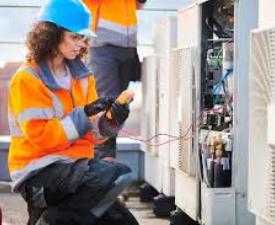
Description
Certification Name: Certificate in HVAC Technician
Course Id: CHVACT/Q0001.
Eligibility: 10th (High School) or Equivalent.
Objective: The Certified HVAC (Heating, Ventilation, and Air Conditioning) Technician course is designed to equip learners with the technical skills and knowledge required to install, maintain, repair, and troubleshoot HVAC systems used in residential, commercial, and industrial settings. This course is ideal for aspiring technicians, electricians, maintenance staff, and individuals seeking a career in the air conditioning and refrigeration industry.
Duration: Three Month.
 How to Enroll and Get Certified in Your Chosen Course:
Step 1: Choose the course you wish to get certified in.
Step 2: Click on the “Enroll Now” button.
Step 3: Proceed with the enrollment process.
Step 4: Enter your billing details and continue to course fee payment.
Step 5: You will be redirected to the payment gateway. Pay the course and exam fee using one of the following methods:
Debit/Credit Card, Wallet, Paytm, Net Banking, UPI, or Google Pay.
Step 6: After successful payment, you will receive your study material login ID and password via email within 48 hours of fee payment.
Step 7: Once you complete the course, take the online examination.
Step 8: Upon passing the examination, you will receive:
• A soft copy (scanned) of your certificate via email within 7 days of examination.
• A hard copy (original with official seal and signature) sent to your address within 45 day of declaration of result.
Step 9: After certification, you will be offered job opportunities aligned with your area of interest.
Online Examination Detail:
Duration- 60 minutes.
No. of Questions- 30. (Multiple Choice Questions).
Maximum Marks- 100, Passing Marks- 40%.
There is no negative marking in this module.
| Marking System: | ||||||
| S.No. | No. of Questions | Marks Each Question | Total Marks | |||
| 1 | 10 | 5 | 50 | |||
| 2 | 5 | 4 | 20 | |||
| 3 | 5 | 3 | 15 | |||
| 4 | 5 | 2 | 10 | |||
| 5 | 5 | 1 | 5 | |||
| 30 | 100 | |||||
| How Students will be Graded: | ||||||
| S.No. | Marks | Grade | ||||
| 1 | 91-100 | O (Outstanding) | ||||
| 2 | 81-90 | A+ (Excellent) | ||||
| 3 | 71-80 | A (Very Good) | ||||
| 4 | 61-70 | B (Good) | ||||
| 5 | 51-60 | C (Average) | ||||
| 6 | 40-50 | P (Pass) | ||||
| 7 | 0-40 | F (Fail) | ||||
Key Benefits of Certification- Earning a professional certification not only validates your skills but also enhances your employability. Here are the major benefits you gain:
Practical, Job-Ready Skills – Our certifications are designed to equip you with real-world, hands-on skills that match current industry demands — helping you become employment-ready from day one.
Lifetime Validity – Your certification is valid for a lifetime — no renewals or expirations. It serves as a permanent proof of your skills and training.
Lifetime Certificate Verification – Employers and institutions can verify your certification anytime through a secure and reliable verification system — adding credibility to your qualifications.
Industry-Aligned Certification –All certifications are developed in consultation with industry experts to ensure that what you learn is current, relevant, and aligned with market needs.
Preferred by Employers – Candidates from ISO-certified institutes are often prioritized by recruiters due to their exposure to standardized, high-quality training.
Free Job Assistance Based on Your Career Interests – Receive personalized job assistance and career guidance in your preferred domain, helping you land the right role faster.
Assessment Modules:
Module 1: Introduction to HVAC Systems: Overview of HVAC (Heating, Ventilation, and Air Conditioning), Types of HVAC systems (Split, Packaged, Central), Basic principles of heat transfer, Components of HVAC systems, Applications in residential and commercial buildings, Safety precautions in HVAC operations.
Module 2: Refrigeration and Cooling Principles: Principles of refrigeration and thermodynamics, Refrigerants and their properties, Refrigeration cycle (Compression, Condensation, Expansion, Evaporation), Evaporators and condensers, Troubleshooting cooling systems, Environmental impact and refrigerant regulations.
Module 3: Heating Systems and Components: Types of heating systems (Furnaces, Boilers, Heat Pumps), Combustion process and fuel types, Heat exchangers and burners, Safety controls and flame sensors, Troubleshooting heating equipment, Energy efficiency in heating systems.
Module 4: Ventilation and Airflow Management: Importance of ventilation in HVAC, Types of ventilation systems (natural, mechanical), Air filters, ducts, and dampers, Air balancing and airflow measurement, Indoor air quality standards, Maintenance of ventilation systems.
Module 5: Electrical and Control Systems in HVAC: HVAC electrical fundamentals (voltage, current, resistance), Wiring diagrams and electrical symbols, Control systems (thermostats, sensors, relays), Motors and compressors, Troubleshooting electrical faults, Preventive maintenance of electrical components.
Module 6: Installation, Maintenance and Regulations: Installation procedures and tools, Charging and recovering refrigerants, Routine maintenance procedures, Diagnosing and repairing system faults, HVAC codes and safety regulations, Customer service and professional ethics.
❄️ Certificate in HVAC Technician
The Certificate in HVAC Technician program is designed to provide individuals with the technical knowledge and practical skills required to install, maintain, and repair heating, ventilation, and air conditioning systems in residential, commercial, and industrial environments.
This program focuses on HVAC system installation, air conditioning maintenance, refrigeration systems, ventilation systems, electrical components, troubleshooting techniques, and preventive maintenance practices. Participants learn how to diagnose HVAC issues, perform system servicing, and ensure efficient climate control in buildings and facilities.
The course also introduces industry standards and safety practices followed by global HVAC manufacturers such as Daikin Industries, Carrier Global, and Voltas.
Certified professionals can work in air conditioning companies, facility management firms, construction companies, manufacturing industries, and maintenance service organizations.
💼 Career Opportunities in India
1️⃣ HVAC Technician
Install, maintain, and repair air conditioning, refrigeration, and ventilation systems.
Average Salary: ₹2.5 – ₹5 LPA
2️⃣ HVAC Service Engineer
Diagnose HVAC system issues, perform technical servicing, and ensure efficient system performance.
Average Salary: ₹4 – ₹8 LPA
3️⃣ HVAC Supervisor
Supervise HVAC installation and maintenance teams, manage projects, and ensure safety compliance.
Average Salary: ₹6 – ₹12 LPA
4️⃣ HVAC Project Manager
Manage large HVAC installation projects for commercial buildings, factories, and infrastructure projects.
Income Potential: ₹10 – ₹20+ LPA
📈 Career Growth Path
HVAC Technician
⬇
HVAC Service Engineer
⬇
HVAC Supervisor
⬇
HVAC Project Manager
⬇
Director – Building Services & HVAC Operations
With expertise in HVAC systems, building climate control, maintenance engineering, and energy-efficient technologies, professionals can advance into senior roles in engineering and facility management.
🏢 Industries Hiring
-
Air Conditioning & HVAC Companies
-
Construction & Infrastructure Companies
-
Facility Management Firms
-
Manufacturing & Industrial Plants
-
Commercial Buildings & Shopping Malls
-
Hotels, Hospitals & Airports
👩🎓 Ideal For
-
Mechanical and Electrical Technicians
-
Maintenance and Service Professionals
-
Engineering Diploma Holders
-
Facility Management Staff
-
Individuals interested in HVAC installation and maintenance careers
