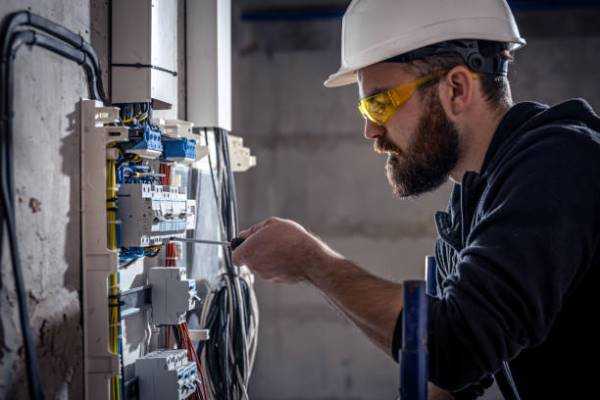
Description
Certification Name: Certificate in Residential Electrician
Course Id: CRE/Q0001.
Eligibility: 10th (High School) or Equivalent.
Objective: The objective of the Certified Residential Electrician course is to provide participants with the knowledge and practical skills required to install, maintain, and repair electrical wiring, lighting, and appliances in homes and residential complexes. The course covers electrical theory, residential wiring methods, circuit design, safety standards, code compliance, and troubleshooting techniques.
Duration: Three Month.
 How to Enroll and Get Certified in Your Chosen Course:
 Step 1: Choose the course you wish to get certified in.
Step 2: Click on the “Enroll Now” button.
Step 3: Proceed with the enrollment process.
Step 4: Enter your billing details and continue to course fee payment.
Step 5: You will be redirected to the payment gateway. Pay the course and exam fee using one of the following methods:
Debit/Credit Card, Wallet, Paytm, Net Banking, UPI, or Google Pay.
Step 6: After successful payment, you will receive your study material login ID and password via email within 48 hours of fee payment.
Step 7: Once you complete the course, take the online examination.
Step 8: Upon passing the examination, you will receive:
• A soft copy (scanned) of your certificate via email within 7 days of examination.
• A hard copy (original with official seal and signature) sent to your address within 45 day of declaration of result.
Step 9: After certification, you will be offered job opportunities aligned with your area of interest.
Online Examination Detail:
Duration- 60 minutes.
No. of Questions- 30. (Multiple Choice Questions).
Maximum Marks- 100, Passing Marks- 40%.
There is no negative marking in this module.
| Marking System: | ||||||
| S.No. | No. of Questions | Marks Each Question | Total Marks | |||
| 1 | 10 | 5 | 50 | |||
| 2 | 5 | 4 | 20 | |||
| 3 | 5 | 3 | 15 | |||
| 4 | 5 | 2 | 10 | |||
| 5 | 5 | 1 | 5 | |||
| 30 | 100 | |||||
| How Students will be Graded: | ||||||
| S.No. | Marks | Grade | ||||
| 1 | 91-100 | O (Outstanding) | ||||
| 2 | 81-90 | A+ (Excellent) | ||||
| 3 | 71-80 | A (Very Good) | ||||
| 4 | 61-70 | B (Good) | ||||
| 5 | 51-60 | C (Average) | ||||
| 6 | 40-50 | P (Pass) | ||||
| 7 | 0-40 | F (Fail) | ||||
 Key Benefits of Certification- Earning a professional certification not only validates your skills but also enhances your employability. Here are the major benefits you gain:
 Practical, Job-Ready Skills – Our certifications are designed to equip you with real-world, hands-on skills that match current industry demands — helping you become employment-ready from day one.
 Lifetime Validity – Your certification is valid for a lifetime — no renewals or expirations. It serves as a permanent proof of your skills and training.
 Lifetime Certificate Verification – Employers and institutions can verify your certification anytime through a secure and reliable verification system — adding credibility to your qualifications.
 Industry-Aligned Certification –All certifications are developed in consultation with industry experts to ensure that what you learn is current, relevant, and aligned with market needs.
 Preferred by Employers – Candidates from ISO-certified institutes are often prioritized by recruiters due to their exposure to standardized, high-quality training.
 Free Job Assistance Based on Your Career Interests – Receive personalized job assistance and career guidance in your preferred domain, helping you land the right role faster.
Assessment Modules:
Module 1: Introduction to Residential Electrical Systems: Basic electrical concepts and terminology, Overview of residential electrical systems, National Electrical Code (NEC) basics for residential wiring, Electrical safety and use of personal protective equipment (PPE), Tools and equipment for residential electricians, Reading and interpreting electrical blueprints.
Module 2: Residential Wiring and Circuitry: Types of residential wiring methods and materials, Installation of branch circuits and feeders, Circuit breaker panels and distribution boards, Wiring outlets, switches, and lighting fixtures, Grounding and bonding in residential systems, Troubleshooting common wiring issues.
Module 3: Electrical Devices and Fixtures Installation: Installation of receptacles, switches, and dimmers, Wiring and installation of lighting systems, Ceiling fans and appliance circuits, Smoke and carbon monoxide detectors installation, Installation of doorbells and security systems, Low-voltage wiring basics.
Module 4: Electrical System Design and Load Calculations: Calculating electrical loads for residential buildings, Designing circuits for appliances and HVAC systems, Energy-efficient electrical design practices, Panel sizing and breaker selection, Load balancing and demand management, Integration with renewable energy sources (solar, etc.).
Module 5: Testing, Maintenance, and Troubleshooting: Using testing instruments (multimeter, voltage tester), Performing circuit continuity and insulation resistance tests, Diagnosing electrical faults and failures, Preventive maintenance procedures, Repairing and replacing faulty components, Safety checks and code compliance verification.
Module 6: Safety, Codes, and Professional Practices: Electrical safety protocols and hazard prevention, Compliance with local and national electrical codes, Lockout/tagout and emergency procedures, Effective communication with clients and team members, Documentation and reporting practices, Continuing education and professional development.
🎓 Certificate in Residential Electrician
A Certificate in Residential Electrician prepares professionals to install, maintain, test, and repair electrical systems in homes and residential buildings. The course covers wiring systems, switchboards, circuit breakers, earthing systems, lighting installation, safety standards, and basic electrical troubleshooting.
Residential Electricians ensure safe power distribution, prevent electrical hazards, and comply with national electrical safety codes. They work closely with civil contractors, interior designers, and homeowners during new construction and renovation projects.
Certified professionals are in demand across housing projects, electrical contracting firms, real estate developers, and facility management companies. Leading employers in India include Larsen & Toubro (L&T), Tata Projects, Shapoorji Pallonji & Co., Godrej Properties, and major electrical contractors and housing developers.
🔹 Career Opportunities in India
1️⃣ Junior Residential Electrician / Apprentice
Assist senior electricians in wiring, fixture installation, switchboard assembly, and safety checks. Gain hands-on training in tools, circuits, and residential electrical layouts.
Salary: ₹2.5 – ₹4.5 LPA (Entry-Level)
₹4 – ₹6 LPA (Experienced)
2️⃣ Residential Electrician
Independently handle wiring, installation of lighting systems, circuit breakers, MCB panels, earthing systems, and troubleshooting electrical faults in homes and apartments.
Salary: ₹4 – ₹8 LPA
3️⃣ Senior Electrician / Team Leader
Supervise residential electrical projects, manage installation teams, ensure compliance with safety regulations, and coordinate with construction supervisors.
Salary: ₹6 – ₹12 LPA
4️⃣ Electrical Supervisor / Contractor
Oversee complete electrical systems for residential complexes, villas, and housing projects. May start an independent electrical contracting business.
Income Potential: ₹8 – ₹18+ LPA (or project-based earnings for contractors)
📈 Career Growth Path
Apprentice → Residential Electrician → Senior Electrician → Electrical Supervisor → Electrical Contractor / MEP Specialist
With additional certifications in industrial electrical systems, solar installation, or smart home automation, professionals can significantly increase income within 3–8 years.
🏢 Industries Hiring
-
Residential Construction Companies
-
Real Estate Developers
-
Electrical Contracting Firms
-
Smart Home Installation Companies
-
Maintenance & Facility Management Services
🎯 Ideal For
-
ITI or Diploma holders in Electrical trades
-
Individuals interested in home wiring and electrical installation
-
Technicians aiming to start independent electrical services
-
Professionals seeking stable technical careers in construction
-
Career switchers into electrical and MEP services