
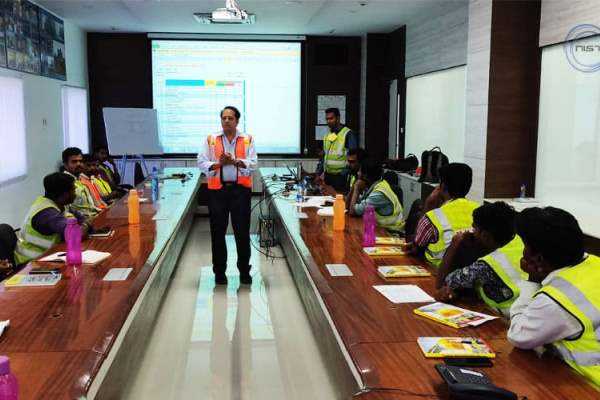
Description
Certification Name: Certificate in Behavioral-Based Safety Practitioner
Course Id: CBBSP/Q0001.
Eligibility: Graduation or Equivalent.
Objective: The Certified Behavior-Based Safety Practitioner course is designed to provide participants with the knowledge and tools needed to create and sustain a proactive safety culture focused on human behavior. The course covers the principles of behavioral psychology, identification of at-risk behaviors, observation techniques, feedback strategies, behavior modification methods, and employee engagement in safety practices.
Duration: Three Month.
 How to Enroll and Get Certified in Your Chosen Course:
Step 1: Choose the course you wish to get certified in.
Step 2: Click on the “Enroll Now” button.
Step 3: Proceed with the enrollment process.
Step 4: Enter your billing details and continue to course fee payment.
Step 5: You will be redirected to the payment gateway. Pay the course and exam fee using one of the following methods:
Debit/Credit Card, Wallet, Paytm, Net Banking, UPI, or Google Pay.
Step 6: After successful payment, you will receive your study material login ID and password via email within 48 hours of fee payment.
Step 7: Once you complete the course, take the online examination.
Step 8: Upon passing the examination, you will receive:
• A soft copy (scanned) of your certificate via email within 7 days of examination.
• A hard copy (original with official seal and signature) sent to your address within 45 day of declaration of result.
Step 9: After certification, you will be offered job opportunities aligned with your area of interest.
Online Examination Detail:
Duration- 60 minutes.
No. of Questions- 30. (Multiple Choice Questions).
Maximum Marks- 100, Passing Marks- 40%.
There is no negative marking in this module.
| Marking System: | ||||||
| S.No. | No. of Questions | Marks Each Question | Total Marks | |||
| 1 | 10 | 5 | 50 | |||
| 2 | 5 | 4 | 20 | |||
| 3 | 5 | 3 | 15 | |||
| 4 | 5 | 2 | 10 | |||
| 5 | 5 | 1 | 5 | |||
| 30 | 100 | |||||
| How Students will be Graded: | ||||||
| S.No. | Marks | Grade | ||||
| 1 | 91-100 | O (Outstanding) | ||||
| 2 | 81-90 | A+ (Excellent) | ||||
| 3 | 71-80 | A (Very Good) | ||||
| 4 | 61-70 | B (Good) | ||||
| 5 | 51-60 | C (Average) | ||||
| 6 | 40-50 | P (Pass) | ||||
| 7 | 0-40 | F (Fail) | ||||
Key Benefits of Certification- Earning a professional certification not only validates your skills but also enhances your employability. Here are the major benefits you gain:
Practical, Job-Ready Skills – Our certifications are designed to equip you with real-world, hands-on skills that match current industry demands — helping you become employment-ready from day one.
Lifetime Validity – Your certification is valid for a lifetime — no renewals or expirations. It serves as a permanent proof of your skills and training.
Lifetime Certificate Verification – Employers and institutions can verify your certification anytime through a secure and reliable verification system — adding credibility to your qualifications.
Industry-Aligned Certification –All certifications are developed in consultation with industry experts to ensure that what you learn is current, relevant, and aligned with market needs.
Preferred by Employers – Candidates from ISO-certified institutes are often prioritized by recruiters due to their exposure to standardized, high-quality training.
Free Job Assistance Based on Your Career Interests – Receive personalized job assistance and career guidance in your preferred domain, helping you land the right role faster.
Assessment Modules:
Module 1: Introduction to Behavioral-Based Safety (BBS): Definition and principles of Behavioral-Based Safety, Evolution and importance of BBS in modern safety culture, Differences between traditional and behavior-based approaches, Core components of an effective BBS program, Roles and responsibilities of a BBS Practitioner, Integration of BBS with overall safety management systems.
Module 2: Understanding Human Behavior and Safety Psychology: Fundamentals of behavior and its influence on safety outcomes, ABC model (Antecedent-Behavior-Consequence) in BBS, Factors affecting unsafe behavior: motivation, perception, habits, Psychological theories relevant to workplace safety, Identifying behavior triggers and reinforcement techniques, Overcoming resistance to behavioral change.
Module 3: Observation Techniques and Behavioral Data Collection: Designing and implementing behavior observation checklists, Conducting effective safety observations and peer-to-peer reviews, Techniques for objective and unbiased observation, Recording and classifying safe vs. at-risk behaviors, Ensuring confidentiality and trust during observations, Observer training and engagement strategies.
Module 4: Feedback, Coaching, and Positive Reinforcement: Principles of effective feedback and behavior reinforcement, Delivering real-time, constructive feedback to workers, Techniques for coaching individuals toward safe behaviors, Role of recognition and reward in sustaining BBS, Dealing with negative or resistant responses, Creating a supportive environment for behavioral change.
Module 5: Data Analysis, Trending, and Behavioral Interventions: Analyzing behavioral data to identify trends and patterns, Linking observation data to incident prevention and root causes, Planning interventions based on behavioral metrics, Developing and implementing corrective and preventive actions, Case studies of successful BBS interventions, Continuous improvement using behavioral insights.
Module 6: Implementation, Communication, and Sustainability of BBS Programs: Steps to design and roll out a BBS program at the workplace, Engaging leadership and building cross-functional teams, Communication strategies for BBS awareness and buy-in, Monitoring progress and revising the BBS program periodically, Integrating BBS with safety training and audits, Ensuring long-term sustainability and cultural adoption of BBS practices.
Career Opportunities After
Certificate in Behavioral-Based Safety (BBS) Practitioner
The Certificate in Behavioral-Based Safety (BBS) Practitioner prepares professionals to implement behavior-driven safety programs that reduce workplace accidents by influencing employee attitudes, habits, and safety culture.
The program develops expertise in behavioral observation techniques, safety culture assessment, human factors analysis, root cause evaluation, safety coaching, incident prevention strategies, performance feedback systems, and leadership engagement in safety initiatives. It equips learners with the ability to build proactive, people-centered safety systems within organizations.
Graduates are highly valued in industries focused on strengthening safety culture and reducing incident rates.
Key Job Roles & Salary Outlook (India)
1. Behavioral-Based Safety Practitioner
Role: Implements and monitors BBS programs to improve workplace safety behavior.
Salary: ₹6 – 14 LPA | ₹14 – 25+ LPA (Experienced)
2. Safety Culture Specialist
Role: Develops strategies to enhance organizational safety culture and employee engagement.
Salary: ₹8 – 18 LPA | ₹18 – 35+ LPA
3. HSE (Health, Safety & Environment) Officer
Role: Integrates behavioral safety practices within overall safety management systems.
Salary: ₹5 – 12 LPA | ₹12 – 22 LPA
4. Risk & Human Factors Analyst
Role: Analyzes behavioral trends contributing to workplace incidents and develops corrective strategies.
Salary: ₹8 – 20 LPA | ₹20 – 40+ LPA
5. Safety Training & Development Manager
Role: Designs and delivers safety leadership and behavioral training programs.
Salary: ₹10 – 25 LPA | ₹25 – 50+ LPA
Top Employment Sectors
-
Manufacturing & Industrial Units
-
Oil & Gas Industry
-
Construction & Infrastructure Projects
-
Power Plants
-
Mining Industry
-
Corporate & Multinational Companies
-
Environmental & Safety Consultancies
-
Government & Public Sector Enterprises
Skills That Accelerate Career Growth
-
Behavioral Observation & Feedback Techniques
-
Safety Culture Assessment
-
Human Factors & Risk Behavior Analysis
-
Incident Root Cause Analysis
-
Safety Leadership & Coaching
-
Communication & Influence Skills
-
Data-Driven Safety Improvement Strategies
-
Continuous Improvement Frameworks
Career Growth Path
Safety Officer
→ BBS Practitioner
→ Senior Safety Consultant
→ Safety Culture Manager
→ HSE Director
→ Chief Safety Officer
Entrepreneurial Opportunities
-
Behavioral Safety Consultancy
-
Corporate Safety Culture Development Programs
-
Safety Coaching & Leadership Training
-
Risk Behavior Assessment Services
-
Organizational Safety Transformation Advisory
Earning Potential in India
-
Entry Level: ₹6 – 10 LPA
-
Mid Level: ₹10 – 20 LPA
-
Senior Level: ₹20 – 50+ LPA
-
Independent Safety Culture Consultant: ₹25 – 70+ LPA depending on projects
