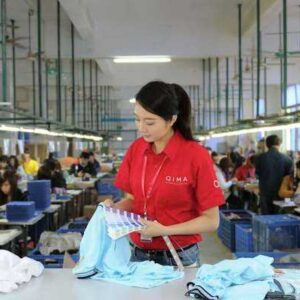
Description
Certification Name: Certificate in Textile & Apparel Production Manager
Course Id: CTAPM/Q0001.
Eligibility: Graduation or Equivalent.
Objective: The objective of the Certified Textile & Apparel Production Manager course is to equip participants with advanced knowledge and practical skills to efficiently manage production processes within the textile and apparel industry. The course covers production planning and scheduling, quality control, resource management, lean manufacturing principles, machinery and technology utilization, and workforce supervision.
Duration: Three Month.
 How to Enroll and Get Certified in Your Chosen Course:
 Step 1: Choose the course you wish to get certified in.
Step 2: Click on the “Enroll Now” button.
Step 3: Proceed with the enrollment process.
Step 4: Enter your billing details and continue to course fee payment.
Step 5: You will be redirected to the payment gateway. Pay the course and exam fee using one of the following methods:
Debit/Credit Card, Wallet, Paytm, Net Banking, UPI, or Google Pay.
Step 6: After successful payment, you will receive your study material login ID and password via email within 48 hours of fee payment.
Step 7: Once you complete the course, take the online examination.
Step 8: Upon passing the examination, you will receive:
• A soft copy (scanned) of your certificate via email within 7 days of examination.
• A hard copy (original with official seal and signature) sent to your address within 45 day of declaration of result.
Step 9: After certification, you will be offered job opportunities aligned with your area of interest.
Online Examination Detail:
Duration- 60 minutes.
No. of Questions- 30. (Multiple Choice Questions).
Maximum Marks- 100, Passing Marks- 40%.
There is no negative marking in this module.
| Marking System: | ||||||
| S.No. | No. of Questions | Marks Each Question | Total Marks | |||
| 1 | 10 | 5 | 50 | |||
| 2 | 5 | 4 | 20 | |||
| 3 | 5 | 3 | 15 | |||
| 4 | 5 | 2 | 10 | |||
| 5 | 5 | 1 | 5 | |||
| 30 | 100 | |||||
| How Students will be Graded: | ||||||
| S.No. | Marks | Grade | ||||
| 1 | 91-100 | O (Outstanding) | ||||
| 2 | 81-90 | A+ (Excellent) | ||||
| 3 | 71-80 | A (Very Good) | ||||
| 4 | 61-70 | B (Good) | ||||
| 5 | 51-60 | C (Average) | ||||
| 6 | 40-50 | P (Pass) | ||||
| 7 | 0-40 | F (Fail) | ||||
 Key Benefits of Certification- Earning a professional certification not only validates your skills but also enhances your employability. Here are the major benefits you gain:
 Practical, Job-Ready Skills – Our certifications are designed to equip you with real-world, hands-on skills that match current industry demands — helping you become employment-ready from day one.
 Lifetime Validity – Your certification is valid for a lifetime — no renewals or expirations. It serves as a permanent proof of your skills and training.
 Lifetime Certificate Verification – Employers and institutions can verify your certification anytime through a secure and reliable verification system — adding credibility to your qualifications.
 Industry-Aligned Certification –All certifications are developed in consultation with industry experts to ensure that what you learn is current, relevant, and aligned with market needs.
 Preferred by Employers – Candidates from ISO-certified institutes are often prioritized by recruiters due to their exposure to standardized, high-quality training.
 Free Job Assistance Based on Your Career Interests – Receive personalized job assistance and career guidance in your preferred domain, helping you land the right role faster.
Assessment Modules:
Module 1: Introduction to Textile & Apparel Production Management: Overview of Textile and Apparel Production Processes, Key Responsibilities of a Production Manager in the Textile Industry, Understanding the Flow of Materials from Design to Finished Product, The Role of Production Management in Cost Control and Quality Assurance, Production Planning vs. Production Scheduling, Introduction to Lean Manufacturing and Waste Reduction.
Module 2: Production Planning and Scheduling: Principles of Production Planning and Forecasting in Textiles, Developing Efficient Production Schedules and Timelines, Managing Capacity and Resources in Textile Manufacturing, How to Balance Production Demand with Material Availability, The Importance of Inventory Management in Production Planning, Tools and Techniques for Effective Scheduling (MRP, ERP Systems).
Module 3: Manufacturing Process and Quality Control: Overview of Textile Manufacturing Processes (Spinning, Weaving, Knitting, Dyeing, Finishing), Key Stages in Apparel Production (Cutting, Sewing, Assembly), Quality Control in Textile and Apparel Production, Setting and Monitoring Quality Standards, Defect Detection and Prevention Techniques, Implementing Six Sigma and Other Quality Management Tools.
Module 4: Supply Chain and Vendor Management in Production: Understanding the Role of Suppliers and Vendors in Textile Production, Vendor Sourcing, Selection, and Relationship Management, Managing Lead Times and Supplier Performance, Collaboration with Suppliers for Cost Optimization, Ensuring Raw Material Availability and Timely Deliveries, Tracking Production Materials Through the Supply Chain.
Module 5: Costing, Budgeting, and Resource Management: Costing Methods in Textile & Apparel Production, Developing Budgets for Production and Operations, Managing Labor Costs, Machine Utilization, and Overhead, Cost Control Strategies for Reducing Waste and Improving Efficiency, Optimizing Resource Allocation (Human, Material, Equipment), Financial Reporting and Analyzing Production Costs.
Module 6: Technology, Sustainability, and Continuous Improvement: The Role of Technology and Automation in Textile Production, Implementing Sustainable Manufacturing Practices and Eco-Friendly Technologies, The Impact of Industry 4.0 and Smart Factories on Apparel Production, Monitoring and Analyzing Production Data for Continuous Improvement, Training and Development for Production Teams, Preparing for Future Trends in Textile and Apparel Production Management.
career options and salary ranges in India after completing a Certificate in Textile & Apparel Production Manager course:
1. Textile & Apparel Production Manager
Role: Oversee and manage end-to-end production processes in textile and apparel units, including planning, scheduling, workflow optimization, quality control, and manpower management.
Salary Range: ₹5 LPA – ₹10 LPA (entry–mid level), ₹10 LPA – ₹20 LPA+ (experienced/senior level)
2. Apparel Manufacturing Manager
Role: Supervise garment manufacturing operations, ensure production targets, manage line efficiency, and coordinate with merchandising, sourcing, and QA teams.
Salary Range: ₹6 LPA – ₹12 LPA
3. Textile Operations Manager
Role: Manage overall operations in textile units including spinning, weaving/knitting, dyeing, finishing, and fabric inspection; optimize resources and reduce costs.
Salary Range: ₹6 LPA – ₹12 LPA
4. Garment / Apparel Plant Manager
Role: Lead garment factory operations, oversee production lines, implement SOPs, ensure timely delivery, and maintain quality and safety standards.
Salary Range: ₹7 LPA – ₹15 LPA
5. Production Planning & Control Executive
Role: Plan production schedules, monitor workflow, manage inventory, and coordinate with procurement, design, and merchandising teams.
Salary Range: ₹5.5 LPA – ₹10 LPA
6. Technical & Process Improvement Manager
Role: Analyze production processes, implement lean manufacturing, productivity improvement techniques, and cost reduction strategies.
Salary Range: ₹6 LPA – ₹12 LPA
7. Entrepreneur / Textile & Apparel Production Consultant
Role: Start or manage a textile/apparel production unit, or offer consultancy services in production management, efficiency, and workflow optimization.
Earnings: ₹10 LPA – ₹35 LPA+ depending on scale and client base
Experience-Based Salary Growth
| Experience Level | Salary Range (INR/Year) |
|---|---|
| Entry (0–2 yrs) | ₹5 L – ₹8 L |
| Mid (3–5 yrs) | ₹8 L – ₹15 L |
| Senior (5+ yrs) | ₹15 L – ₹30 L+ |
Top Employers in India
-
Textile mills and integrated manufacturing units
-
Apparel export houses and domestic garment companies
-
Fashion and lifestyle brands
-
Technical textile manufacturing units
Higher Career Growth Paths
-
Senior Production Director / Head of Operations
-
COO – Textile & Apparel Manufacturing
-
Plant Head / Factory Director
-
Entrepreneur / Industrial Consultant
Salary Potential at Senior Levels: ₹20 LPA – ₹50 LPA+