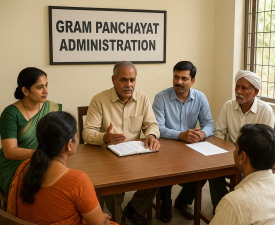
Description
Course Name: Certificate in Gram Panchayat Administration
Course Id: CGPA/Q0101.
Eligibility: 10+2 (Higher Secondary) or equivalent is required.
Objective:This course aims to provide learners with a thorough understanding of the functions and responsibilities of Gram Panchayats in local governance. It covers areas such as rural development, financial management, public service delivery, regulatory compliance, and community participation.
Duration: Three Months.
 How to Enroll and Get Certified in Your Chosen Course:
 Step 1: Choose the course you wish to get certified in.
Step 2: Click on the “Enroll Now” button.
Step 3: Proceed with the enrollment process.
Step 4: Enter your billing details and continue to course fee payment.
Step 5: You will be redirected to the payment gateway. Pay the course and exam fee using one of the following methods:
Debit/Credit Card, Wallet, Paytm, Net Banking, UPI, or Google Pay.
Step 6: After successful payment, you will receive your study material login ID and password via email within 48 hours of fee payment.
Step 7: Once you complete the course, take the online examination.
Step 8: Upon passing the examination, you will receive:
• A soft copy (scanned) of your certificate via email within 7 days of examination.
• A hard copy (original with official seal and signature) sent to your address within 45 day of declaration of result.
Step 9: After certification, you will be offered job opportunities aligned with your area of interest.
Online Examination Detail:
Duration- 60 minutes.
No. of Questions- 30. (Multiple Choice Questions).
Maximum Marks- 100, Passing Marks- 40%.
There is no negative marking in this module.
| Marking System: | ||||||
| S.No. | No. of Questions | Marks Each Question | Total Marks | |||
| 1 | 10 | 5 | 50 | |||
| 2 | 5 | 4 | 20 | |||
| 3 | 5 | 3 | 15 | |||
| 4 | 5 | 2 | 10 | |||
| 5 | 5 | 1 | 5 | |||
| 30 | 100 | |||||
| How Students will be Graded: | ||||||
| S.No. | Marks | Grade | ||||
| 1 | 91-100 | O (Outstanding) | ||||
| 2 | 81-90 | A+ (Excellent) | ||||
| 3 | 71-80 | A (Very Good) | ||||
| 4 | 61-70 | B (Good) | ||||
| 5 | 51-60 | C (Average) | ||||
| 6 | 40-50 | P (Pass) | ||||
| 7 | 0-40 | F (Fail) | ||||
 Key Benefits of Certification- Earning a professional certification not only validates your skills but also enhances your employability. Here are the major benefits you gain:
 Practical, Job-Ready Skills – Our certifications are designed to equip you with real-world, hands-on skills that match current industry demands — helping you become employment-ready from day one.
 Lifetime Validity – Your certification is valid for a lifetime — no renewals or expirations. It serves as a permanent proof of your skills and training.
 Lifetime Certificate Verification – Employers and institutions can verify your certification anytime through a secure and reliable verification system — adding credibility to your qualifications.
 Industry-Aligned Certification –All certifications are developed in consultation with industry experts to ensure that what you learn is current, relevant, and aligned with market needs.
 Preferred by Employers – Candidates from ISO-certified institutes are often prioritized by recruiters due to their exposure to standardized, high-quality training.
 Free Job Assistance Based on Your Career Interests – Receive personalized job assistance and career guidance in your preferred domain, helping you land the right role faster.
Syllabus:
Certificate in Gram Panchayat Administration
Module 1: Foundations of Gram Panchayat Introduction to Panchayati Raj System, Constitutional Provisions (73rd Amendment Act), Structure and Composition of Gram Panchayat, Role and Functions of Gram Panchayat, Gram Sabha and its importance, Legal Framework for Panchayats, Powers and Responsibilities of Sarpanch and Ward Members, Role of Secretary in Gram Panchayat, Gram Panchayat as a Local Government Body, Women’s Participation in Panchayats.
Module 2: Panchayat Governance and Planning Participatory Planning Process, Gram Panchayat Development Plan (GPDP), Sustainable Development Goals (SDGs) at local level, Public Policy and Service Delivery, E-governance in Panchayats, Financial Management and Budgeting, Resource Mobilization and Revenue Generation, Audit and Accountability in Panchayats, Grievance Redressal Mechanisms, Transparency and Social Audit.
Module 3: Rural Development Schemes and Programmes Mahatma Gandhi National Rural Employment Guarantee Act (MGNREGA), National Rural Livelihood Mission (NRLM), Pradhan Mantri Awas Yojana (PMAY), Swachh Bharat Mission (Grameen), National Health Mission (NHM), Mid-Day Meal Scheme, Integrated Child Development Services (ICDS), Jal Jeevan Mission, Digital India Land Records Modernization Programme (DILRMP), Schemes for Vulnerable Sections (SC/ST, Women, etc.).
Module 4: Financial Administration and Accounting Panchayat Samiti and Zilla Parishad, Tax and Non-Tax Revenue Sources, Grants from Central and State Governments, Budget Preparation and Approval Process, Accounting Procedures and Record Keeping, Public Financial Management System (PFMS), Fund Management and Utilization Certificates, Financial Reporting, Internal and External Audit, Best Practices in Financial Management.
Module 5: Project Management and Implementation Project Life Cycle in Panchayats, Needs Assessment and Project Identification, Feasibility Study and Detailed Project Report (DPR), Procurement and Tendering Procedures, Implementation and Monitoring of Projects, Quality Control and Maintenance, Conflict Resolution in Project Implementation, Community Contracting, Documentation and Reporting, Project Evaluation and Impact Assessment.
Module 6: Fieldwork and Case Studies Case Studies of Successful Gram Panchayats, Best Practices in Gram Sabha Meetings, Field Visit to a Gram Panchayat, Interaction with Local Officials and Community Members, Understanding Challenges in Rural Administration, Data Collection and Survey Techniques, Report Writing on Field Experiences, Role of Technology in Rural Governance, Preparing a Gram Panchayat Action Plan, Final Project Presentation on a Rural Development Initiative.
Career Opportunities & Salary Ranges
1. Gram Panchayat Secretary, Panchayat Executive Officer (PEO), or Extension Officer (GPEO)
-
Salary: ₹22,000 – ₹35,000 per month
Typical for Odisha-type roles:-
PEO: ₹22,000–₹32,000 monthly
-
GPEO: ₹25,000–₹35,000 monthly
-
-
Various panchayat roles
-
Positions like Secretary, Executive Assistant, System Manager: ₹22,700 – ₹82,900+, depending on level and allowances
-
Overall Pay Level 9: ₹28,900–₹74,500/month
-
2. Village Development Officer (VDO), Junior Engineer (JE), Accountant, Mukhya Sevika
-
VDO: ₹75,000–₹1,00,000 per month
-
Junior Engineer: ₹50,000–₹75,000 per month
-
Accountant (Gram Panchayat): ₹35,000–₹45,000 per month
-
Mukhya Sevika: ₹40,000–₹60,000 per month
3. Diploma-Level Opportunities & NGOs
-
For those pursuing diplomas (like in Rural Governance & Local Administration), roles such as Panchayat Secretary, Rural Development Assistant, Community Development Officer, Project Coordinator, or Policy Advisor are common.
-
Entry-level (0–3 years): ₹2.5–4.5 LPA (~₹20,800–₹37,500/month)
-
Mid-level (3–5 years): ₹5–8 LPA (~₹41,600–₹66,600/month)
-
Senior-level (5+ years): ₹8–15 LPA (~₹66,600–₹1,25,000/month)
-
Summary Table: Career & Salary Snapshot
| Role / Career Path | Approx. Salary (Monthly) |
|---|---|
| PEO / GPEO / Panchayat Secretary | ₹22,000 – ₹35,000 |
| Accountant / A.C. DEO (Odisha) | ₹18,000 – ₹25,000 |
| Junior Engineer (Panchayat Raj Dept.) | ₹28,000 – ₹40,000 |
| Mukhya Sevika | ₹40,000 – ₹60,000 |
| Gram Panchayat Secretary / System Manager (WB) | ₹22,700 – ₹82,900+ |
| Village Development Officer (VDO) | ₹75,000 – ₹1,00,000 |
| NGO / Development Roles (Diploma Graduates) | ₹20,800–1,25,000/month (~₹2.5–15 LPA) |
Career Advancement & Additional Insights
-
Promotions in these roles are often tied to experience, departmental exams, or performance. For example, Gram Panchayat Secretaries can advance to Block Development Officer (BDO) or other administrative roles.
-
Field-specialized diplomas significantly boost opportunities in NGOs, rural development bodies, and consultancy roles—especially as India strengthens Panchayati Raj institutions.
Final Thoughts
A Certificate in Gram Panchayat Administration can open doors to government jobs in rural governance—ranging from administrative to technical roles. Salaries vary by state and job level, with positions like Village Development Officer offering some of the highest pay. Supplementing this certificate with further diplomas or experience can lead to roles in NGOs or higher administrative positions with salaries greatly exceeding entry-level government scales.