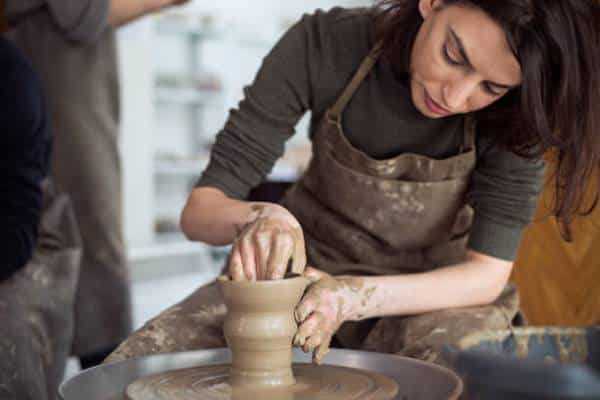
Description
Certification Name: Certificate in Ceramic Artist/Potter
Course Id: CCAP/Q0001.
Eligibility: No Formal Qualification Required
Objective: The Certified Ceramic Artist/Potter course aims to provide students with comprehensive knowledge and hands-on skills in the art and craft of ceramics. The course covers foundational techniques such as wheel throwing, hand-building, glazing, and firing processes, along with advanced methods in design, decoration, and kiln operation. Students will develop artistic expression, technical proficiency, and an understanding of the historical and cultural significance of ceramics.
Duration: Three Month.
 How to Enroll and Get Certified in Your Chosen Course:
 Step 1: Choose the course you wish to get certified in.
Step 2: Click on the “Enroll Now” button.
Step 3: Proceed with the enrollment process.
Step 4: Enter your billing details and continue to course fee payment.
Step 5: You will be redirected to the payment gateway. Pay the course and exam fee using one of the following methods:
Debit/Credit Card, Wallet, Paytm, Net Banking, UPI, or Google Pay.
Step 6: After successful payment, you will receive your study material login ID and password via email within 48 hours of fee payment.
Step 7: Once you complete the course, take the online examination.
Step 8: Upon passing the examination, you will receive:
• A soft copy (scanned) of your certificate via email within 7 days of examination.
• A hard copy (original with official seal and signature) sent to your address within 45 day of declaration of result.
Step 9: After certification, you will be offered job opportunities aligned with your area of interest.
Online Examination Detail:
Duration- 60 minutes.
No. of Questions- 30. (Multiple Choice Questions).
Maximum Marks- 100, Passing Marks- 40%.
There is no negative marking in this module.
| Marking System: | ||||||
| S.No. | No. of Questions | Marks Each Question | Total Marks | |||
| 1 | 10 | 5 | 50 | |||
| 2 | 5 | 4 | 20 | |||
| 3 | 5 | 3 | 15 | |||
| 4 | 5 | 2 | 10 | |||
| 5 | 5 | 1 | 5 | |||
| 30 | 100 | |||||
| How Students will be Graded: | ||||||
| S.No. | Marks | Grade | ||||
| 1 | 91-100 | O (Outstanding) | ||||
| 2 | 81-90 | A+ (Excellent) | ||||
| 3 | 71-80 | A (Very Good) | ||||
| 4 | 61-70 | B (Good) | ||||
| 5 | 51-60 | C (Average) | ||||
| 6 | 40-50 | P (Pass) | ||||
| 7 | 0-40 | F (Fail) | ||||
 Key Benefits of Certification- Earning a professional certification not only validates your skills but also enhances your employability. Here are the major benefits you gain:
 Practical, Job-Ready Skills – Our certifications are designed to equip you with real-world, hands-on skills that match current industry demands — helping you become employment-ready from day one.
 Lifetime Validity – Your certification is valid for a lifetime — no renewals or expirations. It serves as a permanent proof of your skills and training.
 Lifetime Certificate Verification – Employers and institutions can verify your certification anytime through a secure and reliable verification system — adding credibility to your qualifications.
 Industry-Aligned Certification –All certifications are developed in consultation with industry experts to ensure that what you learn is current, relevant, and aligned with market needs.
 Preferred by Employers – Candidates from ISO-certified institutes are often prioritized by recruiters due to their exposure to standardized, high-quality training.
 Free Job Assistance Based on Your Career Interests – Receive personalized job assistance and career guidance in your preferred domain, helping you land the right role faster.
Assessment Modules:
Module 1: Introduction to Ceramics and Pottery: History of ceramics and pottery, Types of clay and their properties, Basic ceramic tools and equipment, Understanding kiln types and firing methods, Safety protocols in the pottery studio, Overview of ceramic art styles and traditions.
Module 2: Clay Preparation and Handbuilding Techniques: Clay wedging and kneading methods, Slab construction techniques, Coil building and joining coils, Pinching method and shaping forms, Surface texturing and embellishments, Drying and greenware handling procedures.
Module 3: Wheel Throwing Fundamentals: Setting up the pottery wheel, Centering clay on the wheel, Pulling walls to create vessels, Trimming and refining shapes, Basic wheel-thrown forms: bowls, cups, cylinders, Common throwing mistakes and troubleshooting.
Module 4: Surface Decoration and Glazing: Types of ceramic glazes and their chemistry, Techniques of glaze application: dipping, brushing, spraying, Underglaze decoration methods, Surface treatments: carving, sgraffito, mishima, Testing glaze results and troubleshooting defects.
Module 5: Kiln Firing Processes and Techniques: Firing schedules and temperature control, Bisque firing fundamentals, Glaze firing procedures, Oxidation vs. reduction atmospheres, Loading and unloading the kiln safely, Troubleshooting common firing issues.
Module 6: Professional Practices and Ceramic Art Development: Portfolio creation and documenting work, Marketing ceramic art and selling strategies, Studio management and cost estimation, Exhibiting ceramics and participating in shows, Exploring contemporary ceramic art trends, Ethical and environmental considerations in pottery.
🎓 Certificate in Ceramic Artist / Potter – Career Overview
After completing this certification, you can build a career in art studios, galleries, handicraft markets, interior design firms, cultural institutions, and freelance projects across India. Ceramic artists and potters create functional and decorative items using clay and ceramic techniques, combining artistry with craftsmanship.
🔝 Career Options & Salary Range (India)
-
Professional Ceramic Artist / Potter – ₹2,50,000 to ₹7,50,000 per year
-
Studio / Gallery Ceramic Artist – ₹3,00,000 to ₹8,50,000 per year
-
Freelance Ceramic Artist / Commissioned Projects – ₹3,50,000 to ₹12,00,000+ per year
-
Interior / Decorative Ceramic Designer – ₹3,50,000 to ₹10,00,000 per year
-
Senior / Lead Ceramic Artist – ₹4,00,000 to ₹12,00,000 per year
(Income varies depending on experience, client base, exhibitions, and city.)
🎯 Key Responsibilities
-
Designing and creating ceramic or pottery items for art, décor, or functional use
-
Shaping, molding, and firing clay using traditional and modern techniques
-
Decorating, glazing, and finishing ceramic products
-
Conducting workshops and training for students and enthusiasts
-
Collaborating with galleries, interior designers, and cultural organizations
📈 Career Growth Path
Apprentice / Trainee → Ceramic Artist / Potter → Professional / Lead Artist → Studio Owner / Instructor → Freelance Specialist
Experienced professionals can exhibit nationally or internationally, sell commissioned works, collaborate with designers, conduct workshops, or run their own pottery studio.
🧠 Skills That Increase Earning Potential
✔ Mastery of pottery and ceramic techniques (wheel throwing, hand-building, glazing)
✔ Knowledge of kiln operations and firing processes
✔ Creativity, design, and attention to detail
✔ Teaching and workshop facilitation
✔ Portfolio building, exhibitions, and networking