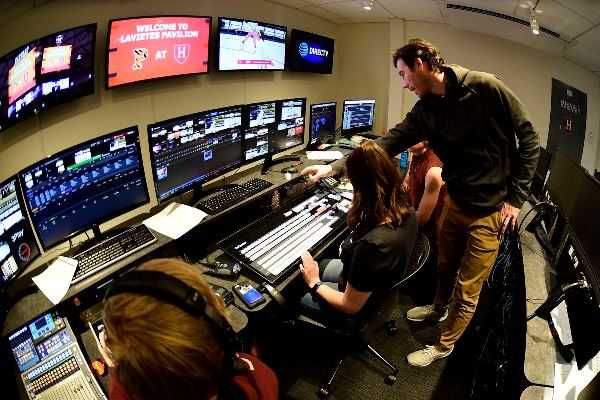
Description
Certification Name: Certificate in Broadcast Production Technician
Course Id: CBPT/Q0001.
Eligibility: Graduation or Equivalent.
Objective: The Certified Broadcast Production Technician course is designed to equip learners with the technical expertise and operational skills required to support live and recorded broadcasting in television, radio, and digital platforms. The course covers the setup, maintenance, and operation of cameras, audio equipment, lighting systems, teleprompters, switchers, and broadcast control rooms. Learners will gain knowledge in signal flow, video and audio standards, studio and field production workflows, live transmission setups, troubleshooting techniques, and compliance with broadcast regulations.
Duration: Three Month.
 How to Enroll and Get Certified in Your Chosen Course:
 Step 1: Choose the course you wish to get certified in.
Step 2: Click on the “Enroll Now” button.
Step 3: Proceed with the enrollment process.
Step 4: Enter your billing details and continue to course fee payment.
Step 5: You will be redirected to the payment gateway. Pay the course and exam fee using one of the following methods:
Debit/Credit Card, Wallet, Paytm, Net Banking, UPI, or Google Pay.
Step 6: After successful payment, you will receive your study material login ID and password via email within 48 hours of fee payment.
Step 7: Once you complete the course, take the online examination.
Step 8: Upon passing the examination, you will receive:
• A soft copy (scanned) of your certificate via email within 7 days of examination.
• A hard copy (original with official seal and signature) sent to your address within 45 day of declaration of result.
Step 9: After certification, you will be offered job opportunities aligned with your area of interest.
Online Examination Detail:
Duration- 60 minutes.
No. of Questions- 30. (Multiple Choice Questions).
Maximum Marks- 100, Passing Marks- 40%.
There is no negative marking in this module.
| Marking System: | ||||||
| S.No. | No. of Questions | Marks Each Question | Total Marks | |||
| 1 | 10 | 5 | 50 | |||
| 2 | 5 | 4 | 20 | |||
| 3 | 5 | 3 | 15 | |||
| 4 | 5 | 2 | 10 | |||
| 5 | 5 | 1 | 5 | |||
| 30 | 100 | |||||
| How Students will be Graded: | ||||||
| S.No. | Marks | Grade | ||||
| 1 | 91-100 | O (Outstanding) | ||||
| 2 | 81-90 | A+ (Excellent) | ||||
| 3 | 71-80 | A (Very Good) | ||||
| 4 | 61-70 | B (Good) | ||||
| 5 | 51-60 | C (Average) | ||||
| 6 | 40-50 | P (Pass) | ||||
| 7 | 0-40 | F (Fail) | ||||
 Key Benefits of Certification- Earning a professional certification not only validates your skills but also enhances your employability. Here are the major benefits you gain:
 Practical, Job-Ready Skills – Our certifications are designed to equip you with real-world, hands-on skills that match current industry demands — helping you become employment-ready from day one.
 Lifetime Validity – Your certification is valid for a lifetime — no renewals or expirations. It serves as a permanent proof of your skills and training.
 Lifetime Certificate Verification – Employers and institutions can verify your certification anytime through a secure and reliable verification system — adding credibility to your qualifications.
 Industry-Aligned Certification –All certifications are developed in consultation with industry experts to ensure that what you learn is current, relevant, and aligned with market needs.
 Preferred by Employers – Candidates from ISO-certified institutes are often prioritized by recruiters due to their exposure to standardized, high-quality training.
 Free Job Assistance Based on Your Career Interests – Receive personalized job assistance and career guidance in your preferred domain, helping you land the right role faster.
Assessment Modules:
Module 1: Introduction to Broadcast Production Technology: Understanding the role of a broadcast production technician in TV and radio, Overview of broadcast systems and workflows, Difference between live, recorded, and streaming broadcasts, Introduction to studio operations and control room functions, Familiarity with different broadcast formats (SD, HD, 4K, IP-based), Basics of broadcast signal flow and transmission paths.
Module 2: Studio Equipment and Setup: Understanding the function of video switchers, audio consoles, and intercom systems, Setting up studio lighting, cameras, microphones, and monitors, Cable types, connectors, and signal routing in broadcast setups, Operation of teleprompters, tally systems, and OB (outside broadcast) units, Troubleshooting common equipment and setup issues, Studio maintenance and power management.
Module 3: Audio and Video Signal Management: Basics of audio signal types, gain staging, and mixing for broadcast, Video signals: analog vs digital, formats, resolutions, and frame rates, Working with SDI, HDMI, XLR, and BNC connections, Syncing audio and video using timecode and genlock, Using waveform monitors, vectorscopes, and peak meters, Ensuring proper levels and quality for broadcast compliance.
Module 4: Live Broadcast and Control Room Operations: Operating vision mixers, graphics generators, and playout systems, Monitoring live feeds, switching camera angles, and cueing talent, Managing IFB (interruptible foldback) and communication systems, Coordinating with directors, anchors, and on-ground crew during live events, Handling broadcast automation systems and rundowns, Managing emergency signals, backups, and continuity.
Module 5: Editing, Graphics, and Playback Systems: Using non-linear editing tools for quick turnaround (Adobe Premiere Pro, EDIUS, DaVinci Resolve), Basics of CG (character generator) systems and live graphics overlays, Managing media ingest, transcoding, and asset naming conventions, Scheduling and cueing playback for promos, commercials, and programs, Working with servers, playout automation, and content backup, Integrating graphics, tickers, and lower thirds into live content.
Module 6: Compliance, Safety, and Technical Documentation: Understanding broadcasting standards and legal compliance (loudness, closed captioning, format), Performing routine checks and preventive maintenance, Logging transmission errors and equipment faults, Following health and electrical safety protocols in studios, Preparing technical reports, checklists, and signal flow diagrams, Building a technician portfolio and preparing for studio or field assignments.
🎓 Career Opportunities After Certificate in Broadcast Production Technician
A Certificate in Broadcast Production Technician prepares professionals to operate and manage technical equipment used in television, radio, and digital broadcasting. The course develops skills in studio operations, camera handling, audio-visual equipment management, live transmission, signal routing, video switching, lighting control, and post-production support.
With India’s growing broadcast industry, regional channels, OTT platforms, and live event coverage, trained broadcast technicians are in high demand in studios, production houses, and media networks.
1️⃣ Broadcast Technician
Key Responsibilities:
Operate cameras, video switchers, audio mixers, and studio equipment; monitor signal quality; troubleshoot technical issues; and ensure smooth live and recorded broadcasts.
Salary in India:
₹2.5 – ₹5 LPA (Entry Level)
₹6 – ₹12 LPA (Experienced Level)
2️⃣ Video / Audio Technician
Key Responsibilities:
Manage video feeds, camera angles, audio levels, lighting systems, and recording devices during live shows or recorded programs.
Salary in India:
₹3 – ₹6 LPA (Entry Level)
₹7 – ₹14 LPA (Experienced Level)
3️⃣ Studio Operations Assistant
Key Responsibilities:
Assist in studio setup, equipment maintenance, teleprompter operations, and coordination with production and on-air teams.
Salary in India:
₹2.5 – ₹5.5 LPA (Entry Level)
₹6 – ₹10 LPA (Experienced Level)
4️⃣ Live Broadcast Engineer
Key Responsibilities:
Supervise live transmissions, ensure signal integrity, manage satellite or IP-based feeds, coordinate with directors and producers, and troubleshoot technical issues in real time.
Salary in India:
₹4 – ₹10 LPA (Entry Level)
₹12 – ₹25 LPA (Experienced Level)
5️⃣ Freelance Broadcast Technician
Key Responsibilities:
Provide technical support for live events, television shoots, corporate broadcasts, webinars, and digital streaming projects. Manage equipment setup, live mixing, and signal routing independently.
Earning Potential in India:
₹30,000 – ₹2,50,000+ per month depending on projects, expertise, and network.
📈 Career Growth Path
Junior Broadcast Technician → Broadcast Technician → Senior Technician / Studio Engineer → Live Broadcast Engineer → Technical Head / Broadcast Operations Manager
With experience in advanced studio technologies, live transmission, digital broadcasting, and team management, professionals can achieve ₹15 – ₹40 LPA within 5–8 years in leading studios and broadcasting networks.
🎓 Industries Hiring
-
Television Channels (National & Regional)
-
Radio Stations
-
OTT & Digital Streaming Platforms
-
Media Production Companies
-
Event Production & Live Broadcast Studios
-
Corporate Communication & Webinar Studios