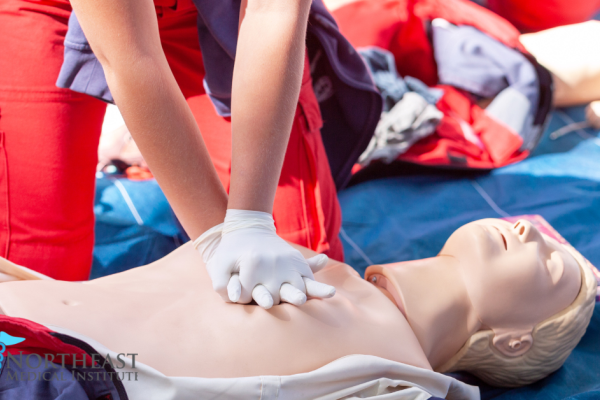
Description
Certification Name: Certificate in Basic Life Support (BLS) Provider
Course Id: CBLSP/Q0001.
Eligibility: 10+2 or Equivalent.
Objective: The Certified Basic Life Support (BLS) Provider course is designed to equip healthcare professionals and trained responders with the essential skills needed to recognize and respond to life-threatening emergencies. The course covers high-quality cardiopulmonary resuscitation (CPR) for adults, children, and infants, the use of Automated External Defibrillators (AED), effective ventilation techniques using barrier devices, and relief of choking in responsive and unresponsive victims.
Duration: Three Month.
 How to Enroll and Get Certified in Your Chosen Course:
 Step 1: Choose the course you wish to get certified in.
Step 2: Click on the “Enroll Now” button.
Step 3: Proceed with the enrollment process.
Step 4: Enter your billing details and continue to course fee payment.
Step 5: You will be redirected to the payment gateway. Pay the course and exam fee using one of the following methods:
Debit/Credit Card, Wallet, Paytm, Net Banking, UPI, or Google Pay.
Step 6: After successful payment, you will receive your study material login ID and password via email within 48 hours of fee payment.
Step 7: Once you complete the course, take the online examination.
Step 8: Upon passing the examination, you will receive:
• A soft copy (scanned) of your certificate via email within 7 days of examination.
• A hard copy (original with official seal and signature) sent to your address within 45 day of declaration of result.
Step 9: After certification, you will be offered job opportunities aligned with your area of interest.
Online Examination Detail:
Duration- 60 minutes.
No. of Questions- 30. (Multiple Choice Questions).
Maximum Marks- 100, Passing Marks- 40%.
There is no negative marking in this module.
| Marking System: | ||||||
| S.No. | No. of Questions | Marks Each Question | Total Marks | |||
| 1 | 10 | 5 | 50 | |||
| 2 | 5 | 4 | 20 | |||
| 3 | 5 | 3 | 15 | |||
| 4 | 5 | 2 | 10 | |||
| 5 | 5 | 1 | 5 | |||
| 30 | 100 | |||||
| How Students will be Graded: | ||||||
| S.No. | Marks | Grade | ||||
| 1 | 91-100 | O (Outstanding) | ||||
| 2 | 81-90 | A+ (Excellent) | ||||
| 3 | 71-80 | A (Very Good) | ||||
| 4 | 61-70 | B (Good) | ||||
| 5 | 51-60 | C (Average) | ||||
| 6 | 40-50 | P (Pass) | ||||
| 7 | 0-40 | F (Fail) | ||||
 Key Benefits of Certification- Earning a professional certification not only validates your skills but also enhances your employability. Here are the major benefits you gain:
 Practical, Job-Ready Skills – Our certifications are designed to equip you with real-world, hands-on skills that match current industry demands — helping you become employment-ready from day one.
 Lifetime Validity – Your certification is valid for a lifetime — no renewals or expirations. It serves as a permanent proof of your skills and training.
 Lifetime Certificate Verification – Employers and institutions can verify your certification anytime through a secure and reliable verification system — adding credibility to your qualifications.
 Industry-Aligned Certification –All certifications are developed in consultation with industry experts to ensure that what you learn is current, relevant, and aligned with market needs.
 Preferred by Employers – Candidates from ISO-certified institutes are often prioritized by recruiters due to their exposure to standardized, high-quality training.
 Free Job Assistance Based on Your Career Interests – Receive personalized job assistance and career guidance in your preferred domain, helping you land the right role faster.
Assessment Modules:
Module 1: Introduction to Basic Life Support and Emergency Systems: Overview and objectives of BLS training, Chain of survival and importance of early intervention, Roles and responsibilities of a BLS provider, Understanding EMS activation and scene safety, Legal and ethical considerations in BLS, Basic infection control and use of personal protective equipment (PPE).
Module 2: Adult CPR and AED Usage: Recognizing cardiac arrest and unresponsiveness, High-quality chest compressions and rescue breaths, One-rescuer and two-rescuer adult CPR techniques, Use of Automated External Defibrillator (AED), Recovery position and post-resuscitation care, Common errors and troubleshooting in CPR performance.
Module 3: Pediatric and Infant CPR Techniques: Differences between adult, child and infant anatomy, Pediatric and infant CPR – hand placement and compression depth, Rescue breathing and airway management for children and infants, Two-rescuer CPR and AED use for pediatric patients, Choking relief in conscious and unconscious children/infants, Safety and emotional considerations in pediatric emergencies.
Module 4: Airway Management and Breathing Emergencies: Opening the airway – head-tilt/chin-lift and jaw-thrust techniques, Rescue breathing for adults, children, and infants, Use of barrier devices and bag-valve-mask (BVM), Recognizing and managing respiratory arrest, Clearing airway obstructions – conscious and unconscious victims, Oxygen administration basics and precautions.
Module 5: Team Dynamics and BLS in Clinical Settings: Effective team roles and responsibilities during BLS, Closed-loop communication and teamwork principles, Coordinating with healthcare professionals during CPR, Scene organization and managing multiple victims, Simulation of in-hospital and out-of-hospital scenarios, Importance of debriefing and continuous improvement.
Module 6: Assessment, Certification and Practical Skills Evaluation: Hands-on practice of CPR, AED, and choking management skills, Scenario-based simulations and emergency drills, Performance assessment using mannequins and checklists, Written test on BLS knowledge and protocols, Feedback and correction of techniques by instructors, Certification criteria and course completion guidelines.
Certificate in Basic Life Support (BLS) Provider
🎓 Career Opportunities After Certificate in Basic Life Support (BLS) Provider
A Certificate in Basic Life Support (BLS) Provider prepares individuals to respond effectively to life-threatening emergencies such as cardiac arrest, respiratory failure, choking, and sudden unconsciousness. The program develops hands-on skills in high-quality CPR (adult, child, infant), Automated External Defibrillator (AED) usage, airway management, rescue breathing, and team-based emergency response.
BLS-certified professionals are highly valued in healthcare, emergency services, aviation, corporate safety, and industrial sectors.
1️⃣ Basic Life Support Provider
Key Responsibilities:
Perform CPR; operate AED; manage airway obstruction; stabilize patients until advanced medical help arrives; follow emergency response protocols.
Salary in India:
₹2.5 – ₹5 LPA (Entry Level – Support Roles)
₹6 – ₹9 LPA (Experienced / Institutional Roles)
2️⃣ Emergency Medical Assistant
Key Responsibilities:
Assist paramedics and doctors; monitor vital signs; prepare emergency equipment; support trauma response; follow BLS protocols aligned with standards from organizations like American Heart Association.
Salary in India:
₹3 – ₹6 LPA (Entry Level)
₹7 – ₹12 LPA (Experienced)
3️⃣ Hospital Code Blue Team Member
Key Responsibilities:
Respond to in-hospital cardiac emergencies; coordinate with medical teams; provide immediate CPR and airway management; document emergency response actions.
Salary in India:
₹3 – ₹7 LPA (Entry Level)
₹8 – ₹15 LPA (Experienced)
4️⃣ Industrial / Corporate Safety Officer
Key Responsibilities:
Ensure workplace emergency preparedness; conduct CPR drills; maintain AED equipment; comply with safety guidelines referencing global health authorities such as World Health Organization.
Salary in India:
₹4 – ₹10 LPA (Mid-Level)
₹12 – ₹20 LPA (Senior Level)
5️⃣ Certified BLS Trainer
Key Responsibilities:
Conduct BLS training sessions; demonstrate CPR techniques; certify participants; organize emergency mock drills; collaborate with hospitals and institutions.
Earning Potential:
₹40,000 – ₹2,50,000+ per month depending on institutional tie-ups and training assignments.
📈 Career Growth Path
BLS Provider → Advanced Life Support (ALS) Certified → Emergency Care Technician → Paramedic → Emergency Response Supervisor → Health & Safety Manager
With advanced certifications (ACLS, PALS, Trauma Care) and field experience, professionals can scale earnings to ₹10 – ₹25 LPA within 5–8 years, especially in hospital and international healthcare sectors.
🎓 Industries Hiring
Hospitals & Emergency Departments
Ambulance & Paramedic Services
Airports & Aviation Industry
Manufacturing & Industrial Units
Educational Institutions
Event Management Companies
Government Disaster Management Agencies
Defense & Security Services