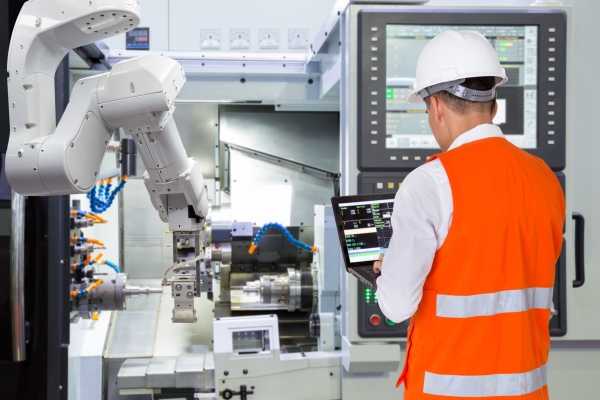
Description
Certification Name: Certificate in Automation Systems Specialist
Course Id: CASS/Q0001.
Eligibility: Graduation or Equivalent.
Objective: The Certified Automation Systems Specialist course is designed to equip participants with in-depth technical knowledge and practical skills to manage end-to-end automation processes in industrial and manufacturing settings. The course covers key components of automation such as PLCs (Programmable Logic Controllers), SCADA systems, HMIs (Human-Machine Interfaces), sensors, actuators, robotics, and control system integration. Participants will learn programming, troubleshooting, system diagnostics, and real-time monitoring techniques.
Duration: Three Month.
 How to Enroll and Get Certified in Your Chosen Course:
 Step 1: Choose the course you wish to get certified in.
Step 2: Click on the “Enroll Now” button.
Step 3: Proceed with the enrollment process.
Step 4: Enter your billing details and continue to course fee payment.
Step 5: You will be redirected to the payment gateway. Pay the course and exam fee using one of the following methods:
Debit/Credit Card, Wallet, Paytm, Net Banking, UPI, or Google Pay.
Step 6: After successful payment, you will receive your study material login ID and password via email within 48 hours of fee payment.
Step 7: Once you complete the course, take the online examination.
Step 8: Upon passing the examination, you will receive:
• A soft copy (scanned) of your certificate via email within 7 days of examination.
• A hard copy (original with official seal and signature) sent to your address within 45 day of declaration of result.
Step 9: After certification, you will be offered job opportunities aligned with your area of interest.
Online Examination Detail:
Duration- 60 minutes.
No. of Questions- 30. (Multiple Choice Questions).
Maximum Marks- 100, Passing Marks- 40%.
There is no negative marking in this module.
| Marking System: | ||||||
| S.No. | No. of Questions | Marks Each Question | Total Marks | |||
| 1 | 10 | 5 | 50 | |||
| 2 | 5 | 4 | 20 | |||
| 3 | 5 | 3 | 15 | |||
| 4 | 5 | 2 | 10 | |||
| 5 | 5 | 1 | 5 | |||
| 30 | 100 | |||||
| How Students will be Graded: | ||||||
| S.No. | Marks | Grade | ||||
| 1 | 91-100 | O (Outstanding) | ||||
| 2 | 81-90 | A+ (Excellent) | ||||
| 3 | 71-80 | A (Very Good) | ||||
| 4 | 61-70 | B (Good) | ||||
| 5 | 51-60 | C (Average) | ||||
| 6 | 40-50 | P (Pass) | ||||
| 7 | 0-40 | F (Fail) | ||||
 Key Benefits of Certification- Earning a professional certification not only validates your skills but also enhances your employability. Here are the major benefits you gain:
 Practical, Job-Ready Skills – Our certifications are designed to equip you with real-world, hands-on skills that match current industry demands — helping you become employment-ready from day one.
 Lifetime Validity – Your certification is valid for a lifetime — no renewals or expirations. It serves as a permanent proof of your skills and training.
 Lifetime Certificate Verification – Employers and institutions can verify your certification anytime through a secure and reliable verification system — adding credibility to your qualifications.
 Industry-Aligned Certification –All certifications are developed in consultation with industry experts to ensure that what you learn is current, relevant, and aligned with market needs.
 Preferred by Employers – Candidates from ISO-certified institutes are often prioritized by recruiters due to their exposure to standardized, high-quality training.
 Free Job Assistance Based on Your Career Interests – Receive personalized job assistance and career guidance in your preferred domain, helping you land the right role faster.
Assessment Modules:
Module 1: Fundamentals of Industrial Automation Systems: Introduction to industrial automation and its applications, Key components: sensors, actuators, controllers, HMIs, PLCs, Levels of automation: field level, control level, supervisory level, Types of automation systems: fixed, programmable, and flexible, Overview of control systems: open-loop vs closed-loop, Safety standards and compliance in automation systems (IEC, ISO).
Module 2: Programmable Logic Controllers (PLC) and Programming: Architecture and operation of PLCs in industrial environments, I/O systems: discrete and analog signals handling, Programming languages: Ladder Logic, FBD, ST, SFC (IEC 61131-3), PLC programming structure: routines, subroutines, scan cycles, Troubleshooting and debugging techniques using simulation tools, Practical exercises on timer, counter, logic, and sequencing operations.
Module 3: Human-Machine Interface (HMI) and SCADA Systems: Role and design of HMI in monitoring and control applications, Interface development: screens, alarms, data trends, and navigation, Introduction to SCADA systems and their architecture, Data acquisition and real-time visualization techniques, Integration of PLCs with HMI/SCADA systems for centralized control, Communication protocols: Modbus, OPC, DNP3, Ethernet/IP.
Module 4: Industrial Communication Networks and Protocols: Basics of industrial networking: topologies, media, and standards, Wired and wireless communication systems in automation, Common protocols: Profibus, Profinet, DeviceNet, CANopen, Fieldbus integration with control systems and field devices, Troubleshooting communication issues and signal integrity checks, Cybersecurity best practices in industrial automation networks.
Module 5: Sensors, Actuators, and Motion Control Systems: Types of sensors: proximity, temperature, pressure, level, photoelectric, Selection and installation of actuators: pneumatic, hydraulic, electric, Basics of motion control: servo motors, stepper motors, VFDs, PID control fundamentals and tuning for process optimization, Feedback systems and signal conditioning techniques, Calibration, maintenance, and fault diagnosis of field devices.
Module 6: System Integration, Testing, and Project Implementation: System design lifecycle: concept, engineering, installation, commissioning, Integration of control components into a unified automation system, Testing methods: FAT (Factory Acceptance Test), SAT (Site Acceptance Test), Documentation: P&ID diagrams, control narratives, wiring layouts, Project management basics: budgeting, scheduling, risk analysis, Capstone project: design and simulate a complete automation system for a manufacturing process.
Key Job Roles & Salary Outlook (India)
1. Automation Engineer
Role: Designs and maintains PLC, SCADA, and control systems.
Salary: ₹5–12 LPA | ₹12–25+ LPA (Experienced)
2. PLC & SCADA Specialist
Role: Programs and configures automation control systems.
Salary: ₹6–14 LPA | ₹14–28+ LPA
3. Industrial Automation Technician
Role: Installs and maintains automation equipment.
Salary: ₹4–9 LPA | ₹9–18+ LPA
4. Robotics Integration Engineer
Role: Integrates robotic systems in production lines.
Salary: ₹8–18 LPA | ₹18–35+ LPA
5. Control Systems Engineer
Role: Designs electrical and process control systems.
Salary: ₹7–16 LPA | ₹16–30+ LPA
Top Employment Sectors
-
Manufacturing & Smart Factories
-
Automotive Industry
-
Food Processing & FMCG
-
Oil & Gas Plants
-
Power Plants & Renewable Energy
-
Warehousing & Automated Logistics
-
Pharma & Chemical Industries
-
Infrastructure & Smart Buildings
Major recruiters include companies such as:
-
Siemens
-
ABB
-
Schneider Electric
-
Honeywell
-
Tata Motors
Skills That Accelerate Career Growth
-
PLC Programming (Siemens / Allen Bradley / Delta)
-
SCADA Development
-
Industrial Networking
-
Robotics Basics
-
Control Panel Wiring & Design
-
VFD & Servo Motor Systems
-
IoT in Automation
-
Root Cause Analysis
-
Preventive Maintenance Planning
Career Growth Path
Automation Technician
→ PLC Engineer
→ Automation Engineer
→ Senior Control Systems Engineer
→ Automation Project Manager
→ Head – Industrial Automation
→ Director – Smart Manufacturing Systems
Entrepreneurial Opportunities
-
Industrial Automation Consultancy
-
PLC Panel Design & Manufacturing
-
Smart Factory Integration Services
-
Robotics System Integration Firm
-
AMC & Maintenance Services
Independent Consultant Potential: ₹20 – 60+ LPA (project dependent)
Earning Potential in India
Entry Level: ₹4 – 8 LPA
Mid Level: ₹8 – 18 LPA
Senior Level: ₹18 – 35+ LPA
Entrepreneur / Consultant: ₹25 – 70+ LPA