Description
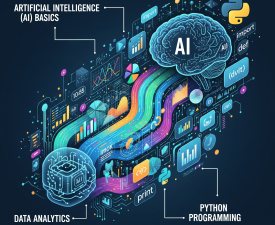
Course Name: Certificate in Artificial Intelligence (AI) Basics + Data Analytics + Python Programming (3 Certifications)
Course Id: CWD/UIUX/BP/Q0101.
Eligibility: 10+2 Grade (Higher Secondary) or equivalent is required.
Objective:This course provides learners with foundational knowledge and skills in three key areas of modern technology. It begins with an introduction to Artificial Intelligence (AI) basics, exploring core concepts, applications, and ethical considerations. The course then covers data analytics, teaching learners how to collect, process, and interpret data to uncover insights and support decision-making.
Duration: Three Months.
 How to Enroll and Get Certified in Your Chosen Course:
 Step 1: Choose the course you wish to get certified in.
Step 2: Click on the “Enroll Now” button.
Step 3: Proceed with the enrollment process.
Step 4: Enter your billing details and continue to course fee payment.
Step 5: You will be redirected to the payment gateway. Pay the course and exam fee using one of the following methods:
Debit/Credit Card, Wallet, Paytm, Net Banking, UPI, or Google Pay.
Step 6: After successful payment, you will receive your study material login ID and password via email within 48 hours of fee payment.
Step 7: Once you complete the course, take the online examination.
Step 8: Upon passing the examination, you will receive:
• A soft copy (scanned) of your certificate via email within 7 days of examination.
• A hard copy (original with official seal and signature) sent to your address within 45 day of declaration of result.
Step 9: After certification, you will be offered job opportunities aligned with your area of interest.
Online Examination Detail:
Duration- 60 minutes.
No. of Questions- 30. (Multiple Choice Questions).
Maximum Marks- 100, Passing Marks- 40%.
There is no negative marking in this module.
| Marking System: | ||||||
| S.No. | No. of Questions | Marks Each Question | Total Marks | |||
| 1 | 10 | 5 | 50 | |||
| 2 | 5 | 4 | 20 | |||
| 3 | 5 | 3 | 15 | |||
| 4 | 5 | 2 | 10 | |||
| 5 | 5 | 1 | 5 | |||
| 30 | 100 | |||||
| How Students will be Graded: | ||||||
| S.No. | Marks | Grade | ||||
| 1 | 91-100 | O (Outstanding) | ||||
| 2 | 81-90 | A+ (Excellent) | ||||
| 3 | 71-80 | A (Very Good) | ||||
| 4 | 61-70 | B (Good) | ||||
| 5 | 51-60 | C (Average) | ||||
| 6 | 40-50 | P (Pass) | ||||
| 7 | 0-40 | F (Fail) | ||||
 Key Benefits of Certification- Earning a professional certification not only validates your skills but also enhances your employability. Here are the major benefits you gain:
 Practical, Job-Ready Skills – Our certifications are designed to equip you with real-world, hands-on skills that match current industry demands — helping you become employment-ready from day one.
 Lifetime Validity – Your certification is valid for a lifetime — no renewals or expirations. It serves as a permanent proof of your skills and training.
 Lifetime Certificate Verification – Employers and institutions can verify your certification anytime through a secure and reliable verification system — adding credibility to your qualifications.
 Industry-Aligned Certification –All certifications are developed in consultation with industry experts to ensure that what you learn is current, relevant, and aligned with market needs.
 Preferred by Employers – Candidates from ISO-certified institutes are often prioritized by recruiters due to their exposure to standardized, high-quality training.
 Free Job Assistance Based on Your Career Interests – Receive personalized job assistance and career guidance in your preferred domain, helping you land the right role faster.
Syllabus:
Module 1: Introduction to Artificial Intelligence (AI)
Overview of AI and its applications, History and evolution of AI, Types of AI (Narrow, General, Super AI), AI vs Human Intelligence, AI in everyday life, Key AI technologies (Machine Learning, NLP, Computer Vision), Ethical considerations in AI, AI trends and future scope, Understanding AI tools and platforms, Case studies of AI implementation.
Module 2: Basics of Data Analytics
Introduction to data analytics, Importance of data-driven decision making, Types of data (structured, unstructured, semi-structured), Data collection methods, Data cleaning and preprocessing, Exploratory data analysis (EDA), Data visualization techniques, Tools for data analytics (Excel, Tableau, Power BI), Introduction to statistical concepts, Case studies in business analytics.
Module 3: Python Programming Fundamentals
Introduction to Python and its applications, Installing Python and IDE setup, Python syntax and basic programming concepts, Variables, data types, and operators, Control structures (if-else, loops), Functions and modules, Working with lists, dictionaries, and tuples, File handling basics, Exception handling, Practical coding exercises.
Module 4: Python for Data Analytics
Using Python libraries (NumPy, Pandas) for data manipulation, Data cleaning and transformation, Data aggregation and grouping, Working with large datasets, Data visualization using Matplotlib and Seaborn, Handling missing values and outliers, Exploratory data analysis with Python, Basic statistical analysis in Python, Introduction to Jupyter Notebook, Mini-project on dataset analysis.
Module 5: AI & Machine Learning Basics
Introduction to Machine Learning, Types of Machine Learning (Supervised, Unsupervised, Reinforcement), Regression and classification techniques, Decision trees and clustering, Model training and evaluation, Overfitting and underfitting concepts, Feature selection and engineering, Using Python libraries for ML (scikit-learn), AI project lifecycle, Mini-project on simple ML model.
Module 6: Practical Applications & Professional Development
Implementing AI solutions in real-life scenarios, Combining Python and data analytics for AI tasks, Hands-on project: Data analysis and predictive modeling, AI tools and platforms overview (TensorFlow, Keras), AI ethics and data privacy, Problem-solving using AI, Freelancing and career opportunities in AI and Data Analytics, Continuous learning and certification paths, Portfolio development, Capstone project – End-to-end AI project using Python and data analytics.
Career Opportunities in India
Entry-Level Roles (0–2 Years)
-
AI/ML Intern
-
Data Analyst Trainee
-
Python Developer Trainee
-
Junior Data Science Associate
-
Business Intelligence (BI) Assistant
Salary Range: ₹3 – 5 LPA
Mid-Level Roles (3–6 Years)
-
Data Analyst / Business Analyst
-
AI/ML Developer
-
Python Programmer / Software Developer
-
Machine Learning Engineer (Junior Level)
-
Data Science Associate
Salary Range: ₹5 – 10 LPA
Senior-Level Roles (7+ Years)
-
Senior Data Analyst / Data Scientist
-
AI/ML Engineer / AI Specialist
-
Python Developer – Advanced Projects
-
Analytics Manager / Team Lead
-
Consultant – AI & Data Solutions
Salary Range: ₹10 – 25+ LPA depending on experience and expertise
Freelancing & Entrepreneurship Opportunities
-
Freelance Python programming and AI project development
-
Data analytics consultancy for businesses
-
AI-based solution development for startups and SMEs
-
Online courses or workshops on AI, Python, and data analytics
-
Developing AI-based tools, chatbots, or automation solutions
Earnings: ₹4 – 25+ LPA depending on project scale, clients, and product/service offerings
Key Skills Gained
-
Fundamentals of Artificial Intelligence and machine learning
-
Python programming for AI, data analysis, and automation
-
Data handling, cleaning, and visualization
-
Basic predictive modeling and statistical analysis
-
Problem-solving using AI algorithms and Python libraries
-
Business intelligence and data-driven decision-making
-
Freelancing and project management skills in AI & Analytics
-
Hands-on experience with tools like Pandas, NumPy, Matplotlib, and Scikit-learn
Summary Table
| Career Stage | Roles | Salary / Earnings Range (₹ LPA) |
|---|---|---|
| Entry-Level | AI/ML Intern, Data Analyst Trainee, Junior Python Developer | 3 – 5 |
| Mid-Level | Data Analyst, Python Programmer, AI Developer | 5 – 10 |
| Senior-Level | Data Scientist, AI Specialist, Analytics Manager | 10 – 25+ |
| Freelancing/Entrepreneurship | AI & Analytics Freelancer, Python Consultant | 4 – 25+ |